
Technology
From Perception to Physical Action.
A technical overview of the capabilities being developed and validated inside Project Dark Brew — and how they connect.
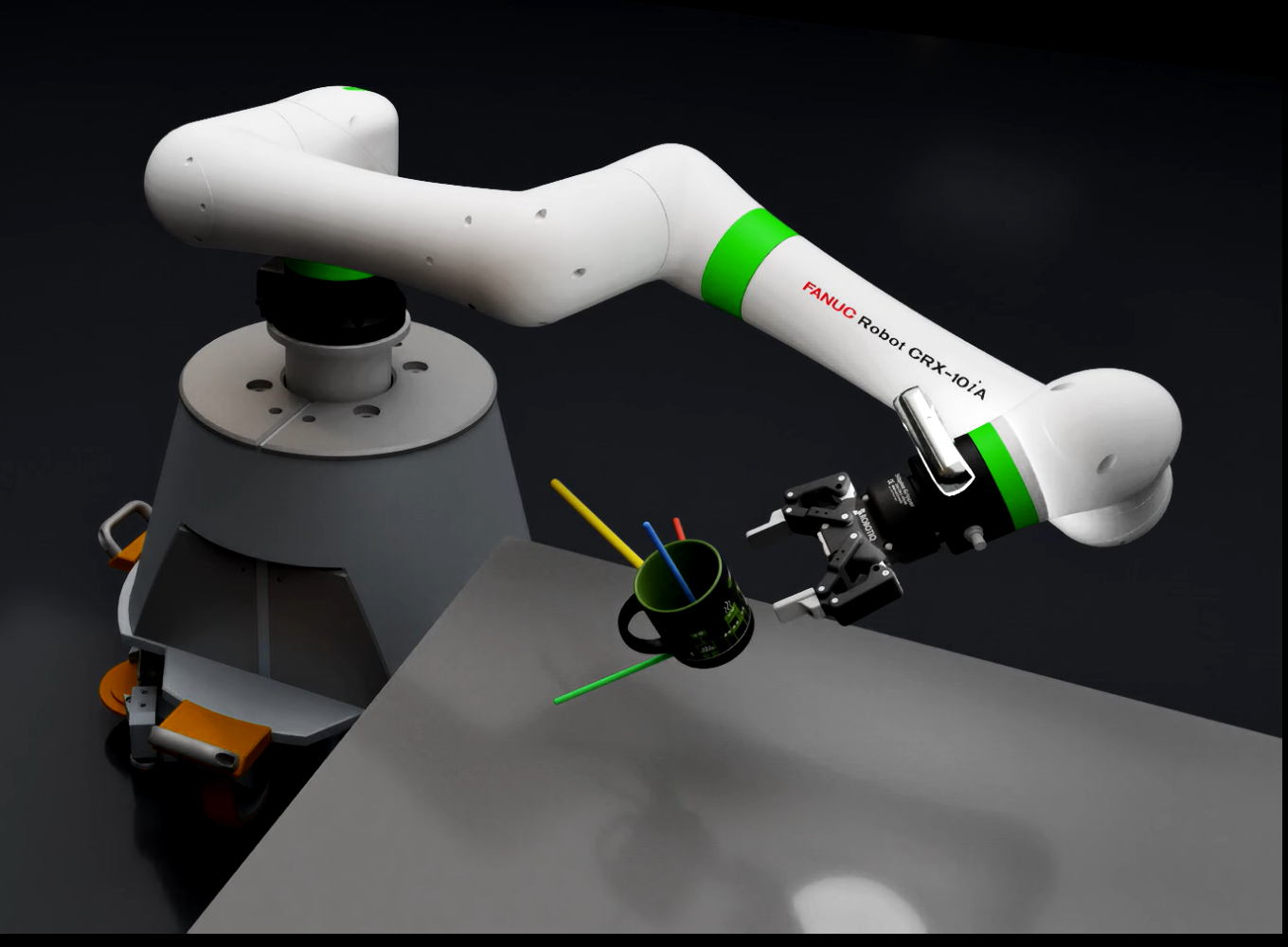
Embodied AI requires more than capable individual modules. Perception must produce trustworthy spatial information. Grasp reasoning must convert that information into actionable targets. Motion planning must translate those targets into reachable robot trajectories. And manipulation must execute reliably enough to complete the physical task.
Project Dark Brew is LYKE's environment for developing, testing, and progressively integrating that chain from perception to physical action. The capabilities below represent components being developed, tested, and progressively integrated into the complete system.
Sensing & Scene Understanding
Perception
The system's ability to observe and interpret the physical environment.
RGB and RGB-D sensing provide the raw input for scene understanding. From that input, the perception pipeline produces object localization, state estimation, and 6DOF pose estimation — the spatial data that downstream reasoning depends on.
Perception development and validation runs inside NVIDIA Isaac Sim, which provides a controlled, repeatable environment for testing against known ground truth before any physical sensor is involved.
Candidate Generation & Evaluation
Grasp Reasoning
Determining how to approach and grasp an object given its observed pose and geometry.
Object-relative grasp templates define candidate grasp families — side-body, rim, bottom, and handle — relative to the object's geometry rather than its absolute position. Because the templates are defined in object-relative coordinates, candidate grasp poses can follow changes in the observed object pose.
Grasp-affordance reasoning evaluates and ranks candidates against feasibility and collision-risk criteria, producing a prioritized set of grasp approaches for the manipulation planner to execute.
Development & Validation Environment
Simulation
The environment where all perception, reasoning, and manipulation work is developed and validated.
NVIDIA Isaac Sim provides the primary development and validation environment for Project Dark Brew. It supports robot kinematics and physics simulation, sensor simulation, and repeatable scene configuration — enabling rigorous testing without physical hardware.
Simulation is a deliberate first stage of LYKE's validation strategy. It enables repeatable testing, known ground truth, controlled failure analysis, and rapid iteration before transitioning capabilities to physical systems.
Execution & Validated Chain
Robotic Manipulation
The robot execution layer — translating grasp plans into coordinated robot motion.
The validated manipulation chain covers the full sequence: approach, grasp, gravity retention, lift, transfer, and hold. Each step has been validated in NVIDIA Isaac Sim using a simulated FANUC CRX-10iA collaborative robot arm and a Robotiq 2F-85 gripper.
Phase 5 work is connecting this validated chain to the perception and grasp reasoning pipeline through a reproducible, hardware-independent runtime — with recorded episode data and replay validation to confirm end-to-end behavior.
SYSTEM ARCHITECTURE
A Runtime Designed for Change
Project Dark Brew is being structured around well-defined data contracts between perception, grasp reasoning, planning, and execution. This allows sensors, AI models, and robot hardware to evolve without requiring the entire manipulation stack to be rewritten.
Modular Inputs
Perception components produce validated object and target-state data rather than exposing sensor-specific assumptions downstream.
Hardware-Independent Execution
Planning and manipulation interfaces are designed so cameras, robot platforms, and end effectors can be replaced or upgraded independently.
Record & Replay
Episode data captures inputs, decisions, transforms, commands, and outcomes so behavior can be reproduced and analyzed without requiring a live camera run.
Current Status
Where the work stands.
Manipulation Chain
End-to-end manipulation chain validated in NVIDIA Isaac Sim.
Integrated Runtime
Connecting perception and manipulation through a reproducible, hardware-independent runtime.
Physical-System Validation
Transition from simulation toward physical hardware and sim-to-real validation.
WHY IT MATTERS
From R&D to Useful Robotic Work
Manufacturers
More adaptable robotic systems for variable tasks that traditionally require extensive programming and fixturing.
Automation Integrators
Reusable perception and manipulation capabilities that can reduce the amount of task-specific engineering required for each deployment.
Robotics & Research Teams
A repeatable environment for developing, testing, recording, and validating embodied-AI behavior before physical-system deployment.
Interested in the technical work?
If you're a researcher, engineer, or institution working in embodied AI, robotic manipulation, or sim-to-real transfer, we're open to discussing collaboration.